
An Electric Pickup Truck combines the practical shape of a traditional work vehicle with a high-voltage electric powertrain. Instead of burning fuel inside an engine, it stores electricity in a large battery pack beneath the cabin and bed. That battery sends energy to one or more electric motors. The motors turn the wheels through a simpler drivetrain, often delivering immediate torque for quick launches and heavy loads.
Ford CEO Jim Farley described the F-150 Lightning as “a workhorse.” That phrase captures the central challenge. An Electric Pickup Truck must handle tools, passengers, rough roads, towing, and daily commuting. Its battery also powers useful features, including onboard outlets and bidirectional charging. In practical terms, a contractor might run lights or equipment from the truck at a remote job site. Charging can happen at home, at public stations, or through faster direct-current equipment.
The system is impressive, but not perfect. Towing a heavy trailer can reduce driving range sharply. Cold weather may slow charging and limit available energy. Large batteries also add weight, which affects tires, braking, and efficiency. Regenerative braking recovers some energy when the truck slows, but it cannot replace careful route planning. This guide will examine the main components, charging process, driving behavior, towing limits, and ownership costs. It will also question common claims, because real-world performance depends on temperature, payload, speed, and charging access. The technology is advancing quickly. The compromises remain important.
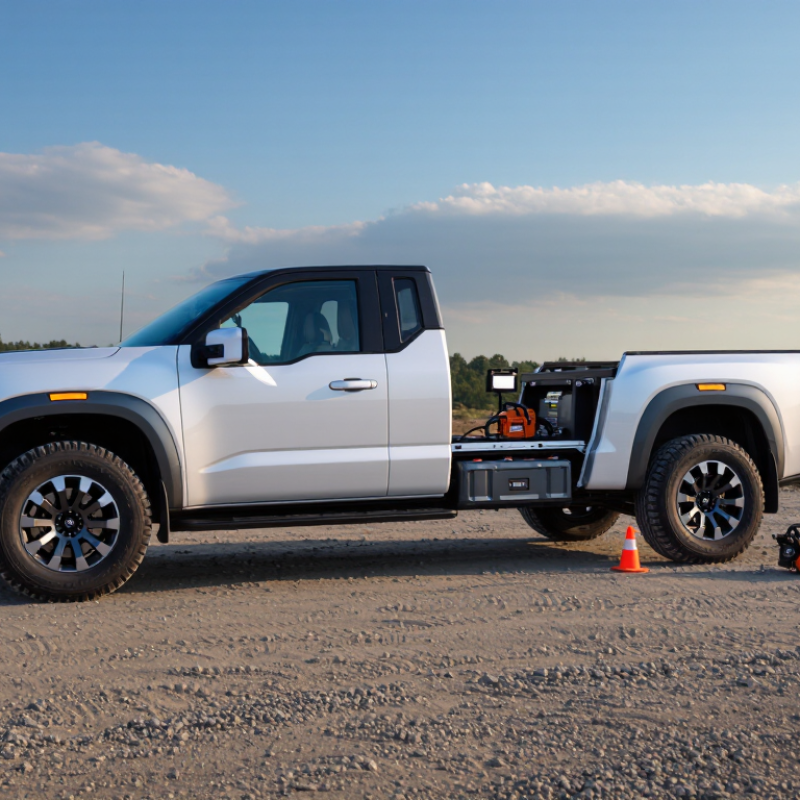
An electric pickup truck is a utility vehicle powered mainly by rechargeable batteries and electric motors. It carries passengers, tools, and cargo while producing no tailpipe emissions during driving. The battery sends direct-current power to an inverter, which controls motor speed and torque. Press the accelerator, and the motor turns the wheels almost immediately. This quick response feels different from a traditional engine. Some models use one motor, while others use separate motors for improved traction. Regenerative braking also returns limited energy to the battery when the vehicle slows.
Core characteristics include a high-voltage battery pack, charging hardware, strong suspension, and a reinforced cargo bed. Battery size affects driving range, payload, towing ability, and charging time. Heavy loads can reduce range more than many first-time owners expect. Thermal management protects the battery in hot or cold conditions. Practical testing matters here. A quoted range may change with weather, tire pressure, speed, and trailer weight. My own view is that electric pickups are capable, but their limits deserve honest attention.
Tips: Check the usable battery capacity, not only the advertised range. Measure your typical cargo weight and towing needs. Keep charging access near home or work when possible. A short test drive can reveal steering feel, bed height, and visibility better than specifications. Regenerative braking may require a brief adjustment.
Representative mid-range characteristics of a battery-electric pickup truck. The vehicle stores electricity in a high-voltage battery, sends it to electric motors, and can recover part of its kinetic energy during braking.
The values shown are realistic reference figures rather than specifications for a particular manufacturer or model. Battery capacity and charging power affect range and charging speed, while payload and towing capacity describe the truck’s practical utility.
An electric pickup truck uses stored battery energy to turn one or more motors. Its main components include the battery pack, inverter, motor, onboard charger, and control software. The battery pack sits low in the chassis, often beneath the cabin and cargo area. This placement lowers the center of gravity, but it can increase exposure to road impacts. A battery management system monitors temperature, voltage, and cell balance. It protects performance, though software is never completely immune to sensor errors.
The inverter changes direct current into the alternating current needed by many traction motors. The motor then produces instant torque through a compact drivetrain. Regenerative braking sends some energy back to the battery during deceleration. According to the U.S. Department of Energy’s Alternative Fuels Data Center, electric vehicles convert about 77%–82% of grid energy into movement, compared with roughly 12%–30% for conventional vehicles. Real-world results vary. Payload, towing, weather, and tire pressure matter greatly.
Thermal management is another essential system. Coolant loops regulate the battery, inverter, and motor during fast charging or heavy towing. The onboard charger converts AC power from a home or public station into battery energy. High-voltage cables connect these systems, while a reinforced frame supports payload and crash protection. The IEA’s Global EV Outlook 2024 reported nearly 14 million electric car sales worldwide in 2023, showing wider production experience across electric drivetrains. Still, pickup applications remain demanding. A larger battery may improve range, but it also adds weight. That trade-off deserves closer testing.
What Is an Electric Pickup Truck and How Does It Work?
How Battery Power Becomes Motion
An electric pickup truck uses stored electrical energy instead of burning fuel. Its battery pack usually sits beneath the cabin and truck bed. This low position helps lower the vehicle’s center of gravity. Hundreds or thousands of cells send direct current through high-voltage cables. The battery management system monitors temperature, voltage, and charge levels. It also protects the cells from harmful electrical conditions.
The inverter changes direct current into controlled alternating current for the motor. The motor creates magnetic force around its internal rotor. That force produces torque, which turns the drive shaft or axle. Gears then transfer this rotation to the wheels. The response feels immediate because electric motors deliver strong torque from very low speeds. A heavy load still demands more energy. Physics remains stubborn.
During braking, the motor can work as a generator. The moving wheels drive the motor, producing electricity for the battery. This process is called regenerative braking. It can reduce brake wear and recover some energy in traffic. However, it cannot restore all the energy used for acceleration. Battery temperature also affects charging speed and available power. Cold weather may reduce range until the pack warms.
Practical driving involves compromises. Towing, steep roads, and strong headwinds increase electrical consumption. A payload may change handling, stopping distance, and energy use. Thermal systems cool the battery, inverter, and motor during demanding work. Charging equipment then replenishes the battery through an onboard charger. The charger converts incoming electricity into a form the battery can safely store. The process is efficient, but not lossless.
What Is an Electric Pickup Truck and How Does It Work?
An electric pickup truck uses a battery pack to power one or more electric motors. Its battery stores energy in kilowatt-hours, or kWh. Larger packs usually support longer trips, but they also add weight. The International Energy Agency reported nearly 14 million electric car sales worldwide in 2023. Pickup adoption is growing, although work loads make its energy demands less predictable.
Charging, Energy Storage, and Driving Range
Home charging is often the most practical choice. The U.S. Department of Energy’s Alternative Fuels Data Center reports that Level 2 equipment can add roughly 10 to 60 miles of range per charging hour. Actual speed depends on the vehicle, charger, battery temperature, and electrical supply. A 240-volt connection may refill a truck overnight, but a heavily depleted battery can take much longer.
Driving range is not a fixed promise. The U.S. Environmental Protection Agency uses standardized tests, yet cold weather, highway speed, payload, and towing can reduce real-world distance. Towing a loaded trailer also increases aerodynamic resistance, much like pushing a box through strong wind. A 100-kWh battery may deliver 300 miles under test conditions, but perhaps far less during winter hauling. That estimate is useful, not perfect. Charging losses also matter, because some electricity becomes heat before reaching the cells. A spreadsheet can still mislead. A driver should check the battery percentage, trailer weight, temperature, and nearby charging options before starting a long trip.
| Category | Data Dimension | Typical or Representative Value | How It Works or Why It Matters |
|---|---|---|---|
| Vehicle System | Primary propulsion | One or more electric motors | Electrical energy is converted into rotational force at the wheels. Electric motors provide immediate torque and do not require a conventional multi-speed transmission. |
| Energy Storage | Battery type | Rechargeable lithium-ion battery pack | The battery stores electricity as chemical energy and releases it as direct current to power the vehicle's inverter and motors. |
| Energy Storage | Usable battery capacity | Approximately 75–150 kWh in many full-size electric pickups | A larger usable capacity can support greater driving range, but it generally increases vehicle weight, cost, and charging time. |
| Energy Storage | Battery voltage | Typically about 400–800 volts | Higher-voltage systems can transfer the same amount of power with lower current, helping reduce electrical losses and support faster charging. |
| Power Conversion | Inverter function | Converts battery DC electricity into variable-frequency AC power | The inverter controls motor speed and torque. During regenerative braking, it can also route electrical energy back to the battery. |
| Charging | Home AC charging power | Approximately 7–19.2 kW, depending on the electrical installation | AC charging is convenient for overnight use. The vehicle's onboard charger converts alternating current into the direct current required by the battery. |
| Charging | Typical overnight charging time | About 8–15 hours for a substantial recharge from a suitable home charger | Charging time depends on battery size, starting state of charge, available circuit power, temperature, and the vehicle's onboard charger limit. |
| Charging | Public DC fast-charging power | Approximately 50–350 kW under compatible conditions | DC fast charging bypasses the vehicle's onboard AC charger and sends controlled direct current to the battery, reducing charging time. |
| Charging | Typical fast-charging session | Roughly 25–45 minutes for a 10%–80% recharge under optimal conditions | Charging usually slows above about 80% to protect the battery and manage heat. The actual time varies with charger output and battery temperature. |
| Charging | Charging efficiency | Approximately 85%–95% from wall electricity to stored battery energy | Some energy is lost as heat during AC-to-DC conversion, battery charging, cabling, and thermal management. |
| Driving Range | Common estimated range | Approximately 240–450 miles (386–724 km) per full charge | Actual range depends on battery capacity, vehicle mass, speed, temperature, terrain, tire choice, payload, towing, and climate-control use. |
| Driving Range | Energy consumption | Approximately 0.30–0.45 kWh per mile (19–28 kWh per 100 km) | Lower consumption generally means more range from the same battery. Pickup-truck aerodynamics, large tires, payload, and towing can increase energy use. |
| Driving Range | Range estimation | Calculated from usable battery energy and recent or predicted efficiency | A simplified estimate is: driving range = usable battery capacity ÷ energy consumption per mile. Vehicle software adjusts the estimate using driving conditions. |
| Regenerative Braking | Energy recovery | Often recovers a portion of braking energy; the amount varies by speed and conditions | When the vehicle slows, the motor operates as a generator and sends electricity back to the battery, reducing friction-brake use. |
| Thermal Management | Battery temperature control | Liquid cooling and heating systems are commonly used | Maintaining an appropriate temperature improves charging performance, power delivery, efficiency, safety, and long-term battery durability. |
| Weather Effects | Cold-weather range impact | Range may decrease by approximately 10%–30% or more in severe conditions | Cold temperatures reduce battery efficiency and require energy for cabin and battery heating. The impact varies with speed, temperature, and preconditioning. |
| Towing and Payload | Effect on driving range | Range can fall substantially, especially during heavy towing or high-speed travel | Additional mass and aerodynamic drag require more motor power. A trailer can have a greater effect than an equivalent payload in the cargo bed. |
| Vehicle Capability | Bidirectional power capability | Available on some electric pickup configurations | Compatible systems may supply electricity to tools, appliances, a building, or another vehicle, subject to hardware, software, and electrical-safety requirements. |
| Environmental Impact | Tailpipe emissions | Zero tailpipe emissions during driving | The vehicle produces no exhaust at the point of use. Total environmental impact also depends on manufacturing, battery production, electricity generation, and recycling. |
Note: Values are representative ranges for modern electric pickup trucks, not specifications for a particular vehicle. Real-world performance varies with configuration, driving conditions, charging equipment, temperature, terrain, payload, and towing.
An electric pickup truck uses battery-stored electricity to power one or more electric motors. Unlike a combustion engine, the motor delivers torque immediately. This response feels strong when moving a loaded trailer from a stop. A large battery pack sits beneath the floor, lowering the vehicle’s center of gravity. Regenerative braking sends some energy back to the battery during deceleration. However, towing, cold weather, heavy cargo, and high speeds can reduce driving range sharply.
Performance is not only about acceleration. A useful electric pickup needs stable handling, dependable cooling, strong suspension, and accurate payload information. Charging can take several hours from a household outlet. A higher-power charger may reduce waiting, but access varies between homes and work sites. Drivers should check connector compatibility, charging rates, and towing range before planning a long trip. Small details matter. A fully loaded bed can change braking distance and energy use.
Utility also carries environmental questions. Electric driving produces no tailpipe emissions, yet battery production requires energy and mined materials. The total climate benefit depends partly on the electricity source and manufacturing process. Recycling systems are improving, but they are not perfect everywhere. I would avoid calling these trucks completely green. That phrase oversimplifies a complicated supply chain. Careful maintenance, efficient driving, correct tire pressure, and charging with cleaner electricity can reduce their operating impact. A practical assessment must consider the vehicle’s entire working life.
