How to Choose Commercial Wall Lights for Global Projects?
Choosing Commercial Wall Lights for global projects requires more than comparing styles, prices, and wattage. Each site brings different climates, building materials, electrical systems, and maintenance expectations. An attractive fixture may corrode near a coastline or create glare across a hotel corridor. These details shape comfort, safety, operating costs, and brand perception.
Experience matters here. After reviewing lighting schedules, mock-ups, and installation feedback, project teams often find small decisions carry large consequences. Beam angle, color consistency, driver access, and spare-part availability deserve early attention. Local professionals should verify applicable electrical, fire, accessibility, and energy requirements before approval. Requirements differ. Reliable manufacturers can provide photometric files, material specifications, test records, and warranty terms. Those documents support clearer comparisons and reduce procurement uncertainty.
This guide examines how to evaluate Commercial Wall Lights for offices, retail spaces, hospitality venues, and public interiors. It considers light distribution, visual comfort, ingress protection, thermal performance, controls, and installation flexibility. A warm 3000K glow may suit a restaurant, while a brighter neutral tone can support a workplace. Neither choice is universally correct. Mock-ups reveal what drawings cannot. Teams should view finishes under actual surfaces, test dimming with planned controls, and inspect junction-box access. Budget remains important, but the lowest purchase price can hide higher replacement and labor costs. Even experienced teams can overlook regional voltage variations or unfamiliar maintenance routines. That is worth admitting. By combining verified data, local expertise, and realistic site testing, decision-makers can choose fixtures that perform consistently across borders. Performance comes first.
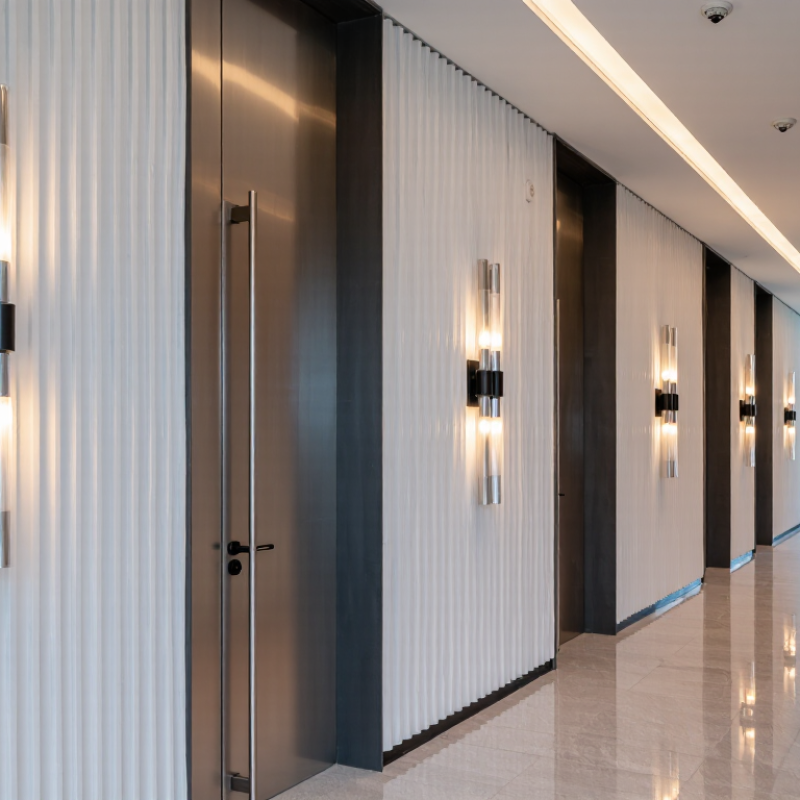
Define Project Requirements and Lighting Objectives
Commercial wall lights should begin with project facts, not appearance. Identify the wall material, mounting height, viewing distance, climate, voltage, and maintenance access. Record the target illuminance and uniformity for each area. A hotel corridor needs calm, even light. A retail façade may require stronger vertical illumination.
The energy target also deserves early attention. The 2023 Global Status Report for Buildings and Construction reports that buildings consume about 30% of global final energy. It also attributes roughly 26% of energy-related emissions to the sector. Efficient lighting supports wider project goals.
The U.S. Department of Energy states that LED lighting can use at least 75% less energy than incandescent lighting and last up to 25 times longer. These figures are useful benchmarks, not automatic guarantees.
Check glare, colour rendering, colour temperature, beam angle, dimming, and emergency-lighting interfaces. Confirm IP protection for exposed locations. Local electrical requirements still control the final specification. They should not be treated as a late-stage detail.
A small mock-up can reveal problems quickly. At dusk, inspect shadows around doorways and uneven brightness across textured walls. We often assume a higher lumen output will improve safety. It may instead create glare and visual fatigue. That assumption needs testing. Photometric files, sample fixtures, and measured site conditions provide stronger evidence than catalogue images. Keep a written record of these decisions for contractors, inspectors, and future maintenance teams.
Assess Wall Light Types, Photometric Performance, and Applications
Choosing Commercial Wall Lights for Global Projects
Wall light selection should begin with the space, not the fixture shape. Up-and-down lights create balanced façades and welcoming hotel corridors. Direct lights suit entrances, stairways, and retail displays that need stronger visibility. Grazing fixtures emphasize textured stone, while indirect designs soften offices and healthcare areas. In narrow corridors, asymmetric optics can place light on the walking surface instead of wasting it on the ceiling.
Photometric data reveals whether a fixture will perform as expected. Check delivered lumens, beam angle, mounting height, and spacing together. A 3,000-lumen fitting may still create dark patches if its beam is too narrow. Review illuminance maps, uniformity, glare ratings, and color consistency. For hospitality spaces, warm color temperatures can feel comfortable. Retail and galleries may require higher color rendering. These choices should follow the task and local lighting criteria, not fashion.
Global projects add practical risks. Confirm voltage range, ambient temperature, moisture protection, impact resistance, and emergency-lighting compatibility. Outdoor coastal walls may need stronger corrosion protection. A dusty transport terminal needs easier cleaning and suitable ingress protection. I once approved a visually elegant wall light before checking maintenance access. The installation looked excellent. Servicing it was awkward. That mistake changed my process. I now inspect photometric files, mock-up photos, wiring plans, and regional compliance requirements before approval. Small details matter.
How to Choose Commercial Wall Lights for Global Projects?
Typical LED planning benchmarks by wall-light type
Bulkhead and wall-pack luminaires generally provide higher lumen output for perimeter, service, and circulation areas, while sconces and recessed wall lights are commonly selected for architectural appearance and lower-level ambient lighting. These indicative ranges support early project comparison; final selection should be verified with manufacturer photometric files, local voltage requirements, glare limits, IP ratings, and site-specific lighting calculations.
Check Electrical Standards, Safety Codes, and Regional Compatibility
How to Choose Commercial Wall Lights for Global Projects?
Commercial wall lights must match local electrical standards, not just the project’s visual concept. Check the supply voltage, frequency, grounding method, and wiring system before approving a fixture. A 220–240V fitting may not suit a region with different electrical conditions. Confirm the required certification marks through local authorities or qualified consultants. Requirements can vary between countries, cities, and building types.
Safety codes deserve equal attention. Review fire performance, insulation, ingress protection, mounting strength, and access for maintenance. Outdoor installations may need higher IP protection, especially near rain, dust, or coastal air. In project reviews, I have seen attractive fixtures fail because their drivers were incompatible with local dimming systems. That mistake is costly. It also delays installation.
Tips: Request test reports, installation drawings, wiring diagrams, and maintenance instructions before shipping. Check whether emergency lighting rules apply. Confirm compatibility with local switches, sensors, and control systems. Keep a regional compliance checklist, but do not trust it blindly. Local review is still necessary. A checklist can miss real site conditions. Ask an electrical engineer to verify the final selection, especially for public buildings, hotels, and healthcare spaces. Keep spare drivers only when local replacement is practical. Good documentation reduces confusion across languages and contractors.
Compare Materials, Durability, Installation, and Maintenance Needs
How to Choose Commercial Wall Lights for Global Projects?
Choosing commercial wall lights for global projects requires more than comparing appearance and price. Material selection should follow local exposure, not showroom appeal. On a coastal hotel project, salt air quickly damaged poorly protected metal finishes. Powder-coated aluminum, stainless steel, and sealed fasteners often perform better in humid environments. Dry interiors may need less protection, but dust can still affect ventilation and optics. Request corrosion data, ingress protection ratings, and photometric files before approval. Details matter.
Installation planning often determines long-term reliability. Record the wall structure, whether concrete, masonry, or drywall. Confirm mounting plates, cable entries, voltage, earthing, and access for maintenance. Local electricians should verify site requirements. A durable light can still fail when technicians cannot reach it safely. I once underestimated lift access on a high corridor installation. The repair schedule became expensive. Test before scaling.
Maintenance needs include more than cleaning the lens. Inspect drivers, seals, fasteners, and color changes during scheduled visits. Dusty warehouses may require frequent cleaning, while sheltered offices need fewer inspections. Choose replaceable components and keep essential spare parts on site. Compare lifetime labor, energy use, and replacement costs, not only purchase prices. Some projects over-specify protection and add unnecessary weight. Conditions change. Review performance after the first season and adjust the maintenance plan.