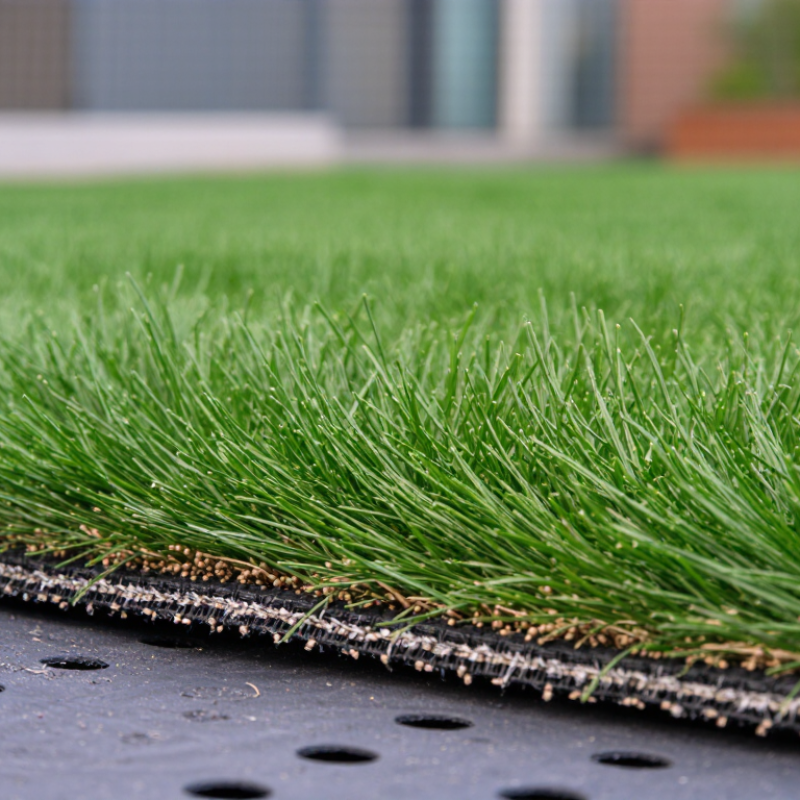
Choosing the best Nylon Turf manufacturer in China requires more than comparing catalog prices. A reliable supplier should demonstrate material knowledge, stable production, and consistent quality control. Nylon fibers must recover after heavy foot traffic. They should also resist abrasion, ultraviolet exposure, moisture, and repeated cleaning. These details matter on sports fields, commercial landscapes, rooftop areas, and indoor activity spaces.
The evaluation should begin with factory evidence. Ask for product samples, fiber specifications, pile height, density, backing structure, and drainage performance. Request test reports from recognized laboratories when available. A professional manufacturer should explain its tufting process, coating method, inspection standards, and packaging controls. Factory photographs are useful, but an independent audit provides stronger evidence. Small details can reveal problems. Look closely at uneven stitching, loose yarn, curling edges, or inconsistent color between sample sections.
No manufacturer is perfect. That matters. Some suppliers may offer excellent yarn but weaker backing systems. Others may provide competitive prices but limited after-sales support. My assessment would remain cautious without checking production records, client references, and warranty terms. A dependable partner should answer technical questions clearly, not hide behind marketing language. It should also help calculate installation waste and maintenance needs.
This guide compares Chinese Nylon Turf manufacturers through product performance, production experience, customization ability, communication, certifications, and long-term reliability. The best choice depends on the project, not simply the lowest quotation. A stadium, playground, and decorative garden need different solutions. Careful comparison creates fewer surprises after installation.
Nylon turf is a synthetic grass surface made from strong nylon fibers. The fibers are usually woven or tufted into a backing layer, then filled with sand or performance infill. Compared with many softer plastics, nylon keeps its shape under heavy foot traffic. It feels springy and responds well to repeated movement. That is why it is often selected for demanding spaces.
Nylon turf appears on sports fields, training areas, playgrounds, rooftop terraces, and busy commercial landscapes. On a small football practice area, dense fibers can recover after players pivot and stop. Around a hotel entrance, the surface can maintain a neat appearance despite luggage wheels and daily visitors. It also works indoors when drainage, ventilation, and fire requirements are carefully checked. Not everywhere.
Choosing a reliable Chinese manufacturer requires more than comparing fiber height or price. Ask for fiber specifications, backing details, UV-resistance data, drainage test results, and production samples. A capable factory should explain yarn density, stitch rate, infill recommendations, and installation limits in clear language. Independent laboratory testing adds credibility, but documents should match the actual shipment. A practical mistake is trusting a sample alone. I have seen surfaces look excellent in a showroom yet perform poorly after weak seaming or insufficient drainage. Factory inspection, batch records, and clear warranty terms deserve equal attention. Even nylon has limits; extreme heat, poor cleaning, and incorrect sub-base preparation can shorten its service life.
Choosing the best nylon turf manufacturer in China requires more than comparing catalog photos. Quality standards reveal how consistently a factory controls materials, production, and testing. ISO 9001 certification can indicate a documented quality management system, but certification alone proves little without recent audit records and corrective-action reports.
For sports applications, buyers should check EN 15330-1 or relevant ASTM testing requirements. These standards may cover pile height, tuft bind, dimensional stability, wear resistance, and ball interaction. Nylon yarn also needs reliable tensile strength, color stability, and resistance to ultraviolet exposure. Independent laboratories working under ISO/IEC 17025 can provide more trustworthy results. Ask for test dates, sample numbers, and the exact product tested.
Environmental and chemical controls matter too. Depending on the destination market, manufacturers may need REACH-related documentation, restricted-substance testing, or ISO 14001 environmental procedures. Factory inspections should include yarn storage, tufting equipment, backing adhesion, drainage layers, and final roll packaging. Small details matter. Uneven stitching can become visible after heavy use. Weak backing may curl at the edges.
My experience with synthetic surfaces suggests that paperwork never replaces physical samples. A factory may meet one standard and still miss project-specific needs. I would compare production samples under sunlight, measure pile height at several points, and request abrasion results from an independent laboratory. Some records may be incomplete. That is a warning, not a minor inconvenience.
Chinese nylon turf manufacturers should be compared by measurable performance, not factory size or catalog photos. Grand View Research estimated the global artificial turf market at roughly US$4.7 billion in 2023, creating a crowded supply landscape. That scale makes quality separation essential. For nylon systems, buyers should verify PA6 or PA66 fiber, dtex, pile height, tuft density, and UV stabilization. These details affect resilience, heat behavior, and replacement cycles. Request batch records for polymers, color masterbatch, backing cloth, and latex. ISO 9001 helps, but it does not prove sports performance. That distinction is often missed.
The FIFA Quality Programme Handbook specifies testing for ball roll, shock absorption, vertical deformation, and rotational resistance. A serious Chinese supplier should provide independent laboratory results for comparable surfaces. EN 15330-1 also supports evaluation of sports-turf construction and performance. Drainage deserves equal attention. Compare drainage rates, seam strength, dimensional stability, and post-installation inspection records. Ask for samples after heat, abrasion, and repeated loading, not only new rolls. Manufacturers with in-house tufting and final inspection usually offer clearer accountability. Still, this is not a perfect rule. An impressive sample can hide inconsistent dye lots or weak seams. Before choosing, inspect one completed field and speak with its maintenance team. That practical check often reveals more than a polished brochure.
Choosing the best nylon turf manufacturer in China requires more than checking price or sample appearance. Buyers should inspect polymer quality, yarn denier, tuft density, backing strength, and production traceability. Grand View Research estimated the global artificial turf market at about USD 3.5 billion in 2023, with continued growth through 2030. That growth increases supplier choice, but also raises quality-control risks.
Request batch-based test reports, not one attractive sample. A competent factory should measure tensile strength, tuft bind, abrasion resistance, colorfastness, and dimensional stability. For sports applications, ask whether testing follows EN 15330-1 or relevant ASTM methods. UV aging should reference ISO 4892-3, while laboratory samples should match shipped production. Check the extrusion line, cooling process, winding tension, and backing-coating temperature. Small process changes can affect blade shape and recovery.
Tips: Ask for three randomly selected rolls. Compare weight, stitch rate, pile height, and shade under daylight. Request photographs of testing equipment and calibration records. Verify drainage tests with your intended infill and base design. A perfect laboratory sheet is not enough. I would also inspect factory records personally, because paperwork can hide inconsistent batches. Some buyers overlook packaging compression, yet crushed yarn may recover slowly after installation. Independent pre-shipment inspection is worthwhile, even when the manufacturer appears experienced.
| Assessment Dimension | What Buyers Should Check | Practical Reference Data | Recommended Evidence | Buyer Evaluation |
|---|---|---|---|---|
| Nylon Yarn Type | Confirm whether the yarn is nylon 6 or nylon 6,6, and review its filament structure, denier, shape, and polymer consistency. | Nylon 6 and nylon 6,6 are both established polyamide materials. Nylon 6,6 generally has a higher melting point, while actual turf performance also depends on construction and additives. | Technical datasheet, polymer declaration, yarn cross-section images, and batch traceability records. | Pass when the yarn specification is consistent across samples and production batches. |
| Yarn Linear Density | Compare yarn denier with pile height, stitch rate, face weight, and intended application. | Common artificial turf yarns may range from approximately 6,000 to 15,000 denier per yarn bundle, but the correct value depends on turf design rather than denier alone. | Measured denier results, product construction sheet, and independent laboratory confirmation. | Avoid comparing products by denier alone; assess total material per square metre and wear performance. |
| Pile Height and Stitch Rate | Verify pile height, gauge, stitches per 10 centimetres, and tuft density against the approved specification. | Decorative and landscape products often use shorter piles, while sports systems may use longer piles. Density must be evaluated together with yarn weight and backing strength. | Tufting-machine settings, production inspection reports, and random roll measurements. | Require tolerances for pile height, gauge, stitch rate, and visible uniformity. |
| Tufting Accuracy | Assess whether the manufacturer controls needle alignment, stitch spacing, pattern consistency, and roll-to-roll variation. | Consistent tufting reduces striping, bald spots, loose yarn, and uneven appearance. Acceptable tolerances should be agreed in the purchase specification. | First-article approval, in-line inspection records, photographs under uniform lighting, and retained samples. | Pass only when the delivered rolls match the approved reference sample. |
| Primary Backing | Check backing material, layer construction, dimensional stability, and resistance to tearing during installation. | Woven and non-woven polypropylene backings are widely used. Backing selection should match climate, installation method, and expected traffic. | Backing composition declaration, tensile-strength results, tear-strength results, and dimensional-change testing. | Look for stable width, clean edges, and no visible delamination or distortion. |
| Secondary Coating and Tuft Bind | Review coating type, application uniformity, curing control, and resistance to yarn pull-out. | Latex and polyurethane systems are common. Coating weight and curing conditions affect tuft bind, flexibility, odor, and long-term stability. | Tuft-bind test results, coating-weight records, curing logs, and sample aging results. | Reject products showing cracking, powdering, strong persistent odor, or loose tufts. |
| UV and Weathering Resistance | Confirm UV stabilizer use and test the complete turf system, not only the polymer resin. | Performance varies with sunlight intensity, temperature, moisture, pigment, and installation conditions. No single test result predicts every climate. | Accelerated weathering reports using a recognized method such as ISO 4892-3 or ASTM G154, plus color-change evaluation. | Require exposure conditions, test duration, color-change criteria, and post-test tensile or appearance results. |
| Color Stability | Check color uniformity between rolls and resistance to fading after UV, heat, and moisture exposure. | Color should be specified using an agreed reference sample or color measurement system. Visual inspection alone is not sufficient for large projects. | Colorimeter readings, approved master sample, and before-and-after weathering photographs. | Set a maximum acceptable color difference before mass production. |
| Abrasion and Wear Resistance | Evaluate fiber splitting, fibrillation, matting, pile recovery, and surface wear under the intended traffic level. | Sports and high-traffic applications require more demanding wear validation than decorative landscaping. Test results should represent the complete product construction. | Laboratory abrasion testing, simulated traffic testing where applicable, and post-test visual assessment. | Compare products using the same test method and exposure level. |
| Tensile and Tear Strength | Check machine-direction and cross-direction strength of the backing and finished carpet. | Strength depends on backing construction, coating, seam design, and test direction. Both directions should be reported. | Independent laboratory test report identifying specimen direction, conditioning, test method, and failure mode. | Use project-specific minimum values rather than relying on a generic marketing claim. |
| Water Permeability and Drainage | Measure vertical permeability and confirm that perforations remain open after coating and storage. | Drainage performance depends on turf, infill, shock pad, sub-base, and site slope. A turf-only result does not guarantee complete system drainage. | Permeability test report, perforation inspection, and project-level drainage design documentation. | Assess the complete installed system for the local rainfall and drainage requirements. |
| Fire Performance | Confirm the required fire classification for the destination market and intended installation. | Fire behavior can change with infill, adhesive, underlay, and sub-base. Testing should represent the final assembly where regulations require it. | Current fire-test report from a competent laboratory and documentation of the tested system composition. | Do not accept a certificate that covers a different backing, coating, or infill system. |
| Chemical and Environmental Compliance | Check restricted substances, heavy metals, volatile emissions, and recyclability information required by the destination market. | Compliance requirements differ by country and product use. Documentation should identify the tested material, production date, and applicable regulation. | Third-party chemical test report, material safety documentation, and written compliance declaration. | Verify that reports are current and apply to the exact product specification. |
| Quality-Control System | Review incoming-material inspection, in-process controls, final inspection, nonconformance handling, and calibration practices. | A documented quality system should control yarn, backing, coating, dimensions, appearance, packaging, and batch release. | Quality manual, inspection plan, calibration records, batch reports, and corrective-action records. | Prefer measurable process controls over final visual inspection alone. |
| Production Capacity and Lead Time | Check available tufting and coating capacity, monthly output, minimum order quantity, and ability to repeat the same construction. | Capacity should be assessed against the required area, roll width, delivery schedule, and expected replenishment orders. | Production plan, capacity statement, sample-to-mass-production timeline, and shipment records with sensitive details removed if necessary. | Treat unrealistic lead-time promises as a supply-chain risk. |
| Pre-Shipment Inspection | Define sampling level, inspection points, roll length, width, weight, appearance, packaging, and labeling requirements. | Inspection criteria should be agreed before production and should include both critical defects and minor appearance deviations. | Signed inspection checklist, measurement photographs, sample retention, and independent inspection option. | Release payment only after agreed inspection documents and corrective actions are completed. |
| Warranty and Technical Support | Review warranty period, exclusions, installation requirements, maintenance conditions, and response procedures for claims. | Warranty validity commonly depends on correct installation, drainage, infill management, cleaning, traffic level, and climate exposure. | Written warranty, installation manual, maintenance schedule, claim process, and spare-material policy. | Choose the manufacturer with the clearest measurable warranty conditions, not simply the longest stated period. |

Choosing a nylon turf manufacturer in China starts with project requirements, not attractive catalog photos. Define pile height, density, yarn shape, color stability, drainage, and installation surface. For sports fields, request abrasion data and recovery tests. For landscaping, assess heat retention and fading under local sunlight. A reliable manufacturer should explain test methods, not only quote impressive numbers. Ask for batch records and current certifications. Details matter.
Request a physical sample with the exact backing and yarn planned for production. Inspect tuft spacing, coating uniformity, edge strength, and odor. Cut a small section and check whether fibers pull out easily. Confirm roll width, length tolerance, packing method, and moisture protection. Independent laboratory testing can verify UV resistance, tensile strength, and drainage performance. Factory videos help, but an on-site audit reveals more. I would review machinery maintenance, warehouse conditions, and final inspection procedures.
Price comparisons can mislead when warranties, spare rolls, and replacement terms differ. Ask how complaints are recorded and resolved, with response times written clearly. Speak with recent buyers about delivery accuracy and after-sales support. A manufacturer may pass a sample test yet struggle with large-volume consistency. That risk deserves a small trial order. Do not ignore communication problems; unclear answers often become costly changes later. The best choice is the supplier whose evidence matches your project, budget, climate, and installation team. Still, no factory is perfect. Leave room for verification.
A practical supplier evaluation should focus on performance, quality control, customization, and delivery capability rather than price alone. The chart presents a buyer-side weighting model for comparing nylon turf manufacturers without using company or brand data.
The percentages represent relative importance in a typical procurement scorecard and should be adjusted according to the project's climate, application, certification requirements, and delivery schedule.